Blogger's note: I just finished watching Pacquiao's 2018 speech before Oxford, and he mentioned Yolanda and Marawi. Mr. Boxer said Marawi was being rehabilitated as he spoke. What a lie. I want to feel optimistic -- that our problems are solvable.
Super typhoon Yolanda is an opportunity for Tacloban and the rest of the Visayas to reboot in a sustainable and democratic way, and perhaps even become a model of development.
But the rebuilding process must be re-thought. The old ways will not survive future calamities, especially with global warming and its stronger, more frequent storms.
We need not look very far. Albay has successfully fought against its destiny of geography. Located as well at the eastern seaboard, Albay (like Aurora, the rest of Bicol, Samar, and northeastern Mindanao) forms part of the country’s typhoon gateway. Albay also gets earthquakes and volcanic eruptions. Because of this triple whammy, Governor Joey Salceda jokingly calls his province the Vatican of Disasters.
After typhoon Sisang, which killed 600 and destroyed P700 million in 1987, and the Mayon Volcano eruption in 1993, the provincial government in 1994 started a successful disaster preparedness program that is constantly being improved. Albay’s measure of success? Except in 2006 when storms Milenyo, Reming, and Seniang altogether killed 755, since 1995 to the present, Albay has had zero casualties.
1. Defense vs disasters starts with a plan.
The first line of defense against disasters is the integration of disaster risk reduction in development and land-use plans, according to Governor Salceda, as cited in a study of Albay disaster preparedness funded by the United Nations Development Program.
Albay’s “safe development” plans are proactive not reactive, evacuation not rescue, institutional not personal, teamwork not individual. Aimed to make the province disaster-proof, these community-based plans are constantly revised for climate change and other hazards.
“The protection of the environment from the effects of human activities and the protection of humans from the effects of the environment are both considered in planning,” according to the study, “Geography and Public Planning: Albay and Disaster Risk Management,” written by Agnes Espinas.
Engineering interventions include: river dikes, sabo dams, sea walls, and drainage systems; and dredging and rechanneling of bodies of water to protect slopes. These should prevent and mitigate the potential damages that may be inflicted on lives and properties.
2. Assess risks, map hazards.
Albay adopted a nine-level land-use measurement for residences, businesses, etc., noting whether they are lowland or upland, with hazards or no hazards, environmentally constrained, under reservation, or are coastal areas and municipal waters. The Mines and Geo-Sciences Bureau and the Philippine Institute of Volcanology and Seismology help Albay constantly upgrade its land-use map.
The province turned the principle of environmental impact assessment on its head. Before, the project came first and the EIA came later; now, the location of infrastructures is pre-determined by the hazards map. Albay’s comprehensive land-use map already lays out where settlements and development projects can be done.
For instance, houses are deemed “highly vulnerable to the impacts of disaster, and the continuous expansion of urban centers may increase [their] vulnerability without any direction for growth.” So Albay “promote(s) settlement growth in areas safe from the risks and hazards of disasters.” The “No Human Activity Area” within the six-kilometer permanent danger zone along the slopes of Mayon Volcano is strictly enforced.
People who live in danger zones and in high-risk areas for flooding, erosion, sink holes, and active fault lines are resettled through a socialized housing program that complies with the Urban Development and Housing Act (Republic Act 7279).
In existing and proposed projects, Albay asks: Is the location within the danger zone? Is it sensitive to hydro-meteorological risks like rising temperature? Is the location threatened by lahar? Is it landslide-prone? Is it flood-prone? Is it at risk to storm surge or sea level rise?
3. Fight global warming with “green” practices and technology.
A warmer Pacific Ocean is believed to create stronger storms. And we’ve seen the destructive power of winds and waves in Yolanda, let us see them — together with abundant solar energy — generate electricity right after the storm has passed.
A small (population: 2,600), agricultural village in Germany is a community that produces its own renewable energy. In fact, Wildpoldsried produces 321% more energy than it needs, generating $5.7 million in annual revenue by selling its excess energy to the national grid. In 1997, the village council decided that it should “build new industries, keep initiatives local, bring in new revenue, and create no debt.” It has since equipped new community buildings with solar panels, built biogas digesters, and installed windmills. Small businesses have developed specifically to provide services to the renewable energy installations. Its 190 private households have solar panels while the district also benefits from its small hydro power plants, ecological flood control, and natural waste water system.
The clean-and-green rebuild can extend to transportation and follow the example of the Dutch. As more than a fifth of global carbon emissions comes from fossil fuel-powered vehicles, biking presents a healthy alternative — for both people and environment.
Rounding up, let’s recycle waste. And when it comes to recycling, Sweden is incredibly successful. Just four percent of household waste in that Scandinavian country goes into landfills; the rest winds up either recycled or used as fuel in waste-to-energy power plants. Sweden is so successful in converting waste into energy that it imports its neighbors’ trash. Two problems solved: Where to get energy? What to do with trash?
Brazil, which is famous for its favelas or slums, applies a different tack. At the Vidigal favela, which had become a dump, an artist named Mauro Quintanilha got together with other volunteers, cleaned up their place, and created flower and kitchen gardens for their community.
4. Design for survival, as well as for the tropics and its devastating winds and lashing rains.
Those who helped rebuild Aceh after the 2004 tsunami say that survivors should not be forced to live in tents for more than six months, as it causes social tension.
Even at the initial stages of rebuilding, the reduce-reuse-recycle mantra must be hummed. Architect Paulo Alcazaren suggests that the trunks of the three million coconut trees felled by Yolanda be used as columns and beams for the 500,000 needed emergency shelters for the displaced. “The roofs can be tarps from all the billboard advertising taken down in Manila (a corporate social responsibility initiative of all Philippine corporations to show they care — if you still have a billboard up, that means you really don’t give a damm). Disasters may strike, but it does not mean we can’t use our coconuts to solve our problems!” he says.

What type of schools to build? Alcazaren looks back to how we built them 100 years ago. “Gabaldon school houses were constructed all over the islands in the early 20th century. The architects based the building on proven tropical design concepts: raising the ground floors against floods, damp earth, and pests, (and) using high-angled hip roofs (that) are more resistant to winds than the low-angled gable roofs of current buildings,” he says.
“The Gabaldons also had high ceilings and large capiz windows for natural light and ventilation. ‘Modern’ schoolhouses are dark and stuffy,” he notes.
Alcazaren, who is also an urban planner, reminds the rebuilders to consider and design “rational transport and communication systems; walkable, well-lit, and tree-shaded streets; compact, mixed-use district morphology; parks and open spaces (for recreation and refuge); and elegant but robust civic buildings.”
Aside from school buildings, the other civic building that normally transforms into an evacuation center during calamities is the stadium.
Alcazaren suggests the following retro-fit to incorporate its secondary post-disaster function: “1) no regular seating, just planking or padded mats that can serve as beds for refugees; 2) rainwater harvested from roof and stored in each column-silo/cistern to be used for toilets; 3) toilets with more than the usual number of stalls, urinals, or showers using the harvested rainwater; and 4) emergency power from generator sets (mandatory) but augmented with solar panels plus pedal power.”
At the same time, the town or city stadium must be “built on elevated sites with additional flat areas around for tents and helicopter landing zones, with emergency clinic and medical supplies embedded here,” he says.
And for emergency communications, he suggests bringing back “ham radio or shortwave — this can be battery powered and will reach Manila and overseas!”
5. Re-channel investments that create “green” jobs and lower environmental risks.
Based on its land-use grading system, Albay limits permanent infrastructure and heavy industries in higher hazard areas, and encourages “rehabilitative,” nature-enhancing (biodiversity), innovative, value-adding (like “hazards” tourism or educational tours on natural hazards) economic activities.
Indonesia’s Banda Aceh, which was levelled by huge seismic-sourced waves in 2004, has tsunami tourism trails.
In these higher hazard areas, high-value crops, pasture, and poultry- and hog-raising are encouraged, as well as forest plantations and plantations of high-value crops which improve vegetative cover, and terrace farming which stabilizes slopes.
As agriculture remains the backbone of the Philippine economy, this sector in Albay promotes technologies that prevent soil erosion within public lands with slope of 30 to 50 percent. Aside from reducing impacts of calamities, these rehabilitate and develop forests, watersheds, and eco-tourism areas.
Plus, all of this reconstruction means jobs, especially for those who lost their means of livelihood in the typhoon.
By the shores, planting mangroves must be encouraged, if not funded. The mangroves in Northern Samar were credited for slowing down the storm surges, saving lives and livelihoods in the process.
6. Involve everyone, especially the poor.
How do we ensure success? Involve everyone. Or in the development language, practice inclusiveness and participative democracy.
In Albay’s case, they involve the people, towns and cities, barangays, church, schools, non-government organizations (local and international), business, the weather bureau, the volcanology institute, the geo-sciences bureau, and all the significant entities.
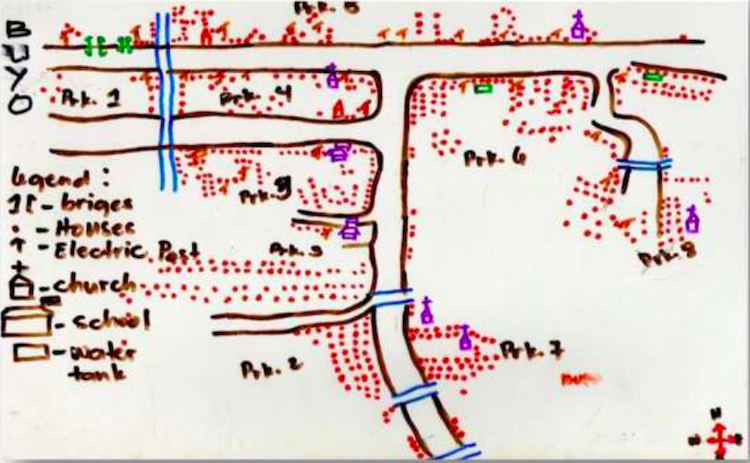
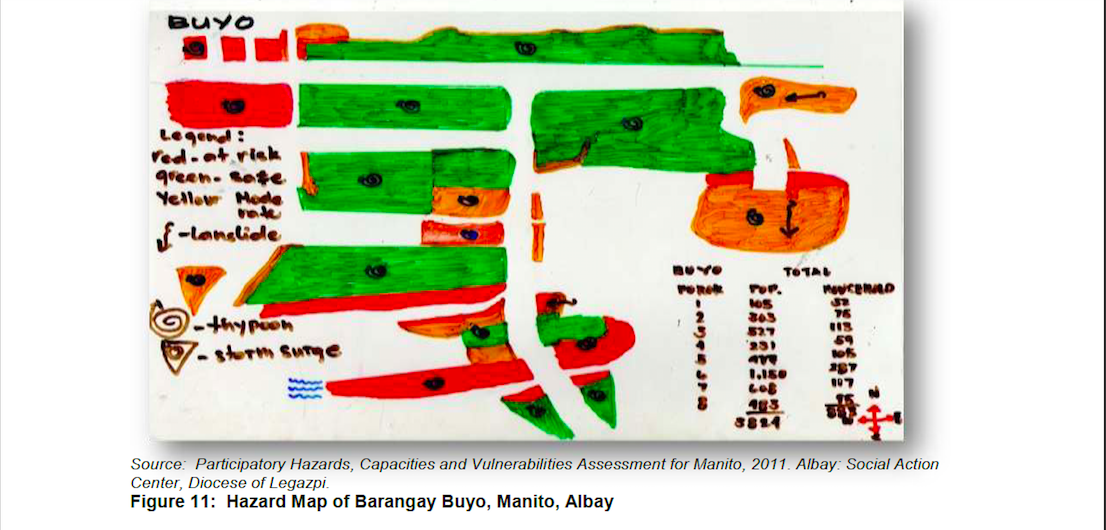
According to the study on Albay, information, communication, education, organization, and mobilization programs improve the communities’ sense of security and confidence. They allow the local communities to help themselves and inspire more community-based early warning systems. Below is an example of a social map and a hazard map of a village in Albay that the residents themselves made in a workshop facilitated by the church.
Also, the goodwill generated by the tragedy everywhere must be harnessed in the rebuilding. We can start asking the international community, including the international NGOs, for these things.
Being inclusive means being pro-poor. Most of those who were most severely affected were poor people in the coastal areas. Getting them involved in the process of rebuilding will help them cope with the trauma and even (yes, let’s be ambitious) overcome their pre-Yolanda poverty.
A lot of Eastern Visayans were hungry even before the super typhoon. Sixteen percent (or one in six) of almost one million families in Eastern Visayas experienced hunger in April, May, and June of 2011, according to the National Statistics Office, which conducted the survey in 2011 but released it only early this year.
Hardest hit by Yolanda, Eastern Visayas is the country’s third poorest region with 37.2 percent of its population (or an estimated 4.2 million people) living below poverty line, according to the National Statistical Coordination Board (NSCB) report for 2012. It came third after the Autonomous Region in Muslim Mindanao (which had a 46.9-percent poverty incidence) and Central Mindanao (37.5 percent).
The economic profile of the region for 2012 shows that despite having a gross domestic product of P228 billion, growth in the region is -6.2 percent, says the NSCB.
7. Eliminate poverty, inequality: Think BIG.
Make social protection universal. Firstly because it is a right, and secondly because the Eastern Visayans need it most now. The Network for Transformative Social Protection defines social protection as those that people need to live. The Asia-based network maintains that governments have the duty to provide these to their citizens: food, shelter, livelihood, health care, education, and basic utilities (water, power, telecommunications). These were partly discussed above.
And in place of the trickle-down effect, why not start from the bottom? The government’s conditional cash transfer (CCT) which gives out money to poor families in exchange for pregnant mothers going for pre-natal check-ups and for children going to school is a start. Why not change the game and expand the bottom-up idea by giving everyone a basic income guarantee (BIG) as a way of eliminating poverty and inequality? The idea of paying citizens a small amount of money enough to survive for simply living — perfect for the Yolanda survivors — is being proposed in Switzerland.
But it was in the Namibia village of Otjivero where the church and the local government co-funded the experiment for two years. There, BIG brought out the best in people. Instead of developing a mendicant mentality, those who received 100 Namibian dollars (about P433) every month gained dignity and became empowered. Much like the trust fund for rich people, BIG not only freed the poor from crushing poverty, it also enabled them to be fully human, living with dignity.
What were the BIG impacts? According to Herbert Jauch of the BIG Coalition in Namibia, it brought down the rates of poverty, unemployment, school drop-out, and crime. As both rich and poor received the allowance (if you will), the rich could not look down on the poor while there was no disincentive for the poor to becoming productive because whether they are or not, whether they wisely use the money and make it grow or not, they still got BIG.
A network in the United States is also campaigning for BIG, arguing too that unlike other social protection schemes, its universality makes it easier and cheaper to administer. Jauch calculates that expanding the program nationwide would be substantial, but cost only a fraction of both Namibia’s GDP (2.2 percent to 3 percent) and its national budget (5 percent to 6 percent). Or for a rough estimate for the Philippines, that’s about P113.25 billion to P135.9 billion, not even 14 times the amount of PDAF allegedly squandered through the bogus NGOs of Janet Lim-Napoles.
In the end, we don’t want to be like Haiti, caught up in the same or worse poverty cycle as before the 2009 earthquake that levelled the poor country.
Remember the goal is for a climate change-resilient, people-centered, green community. The money is there. The knowledge is there. Now, all we need is somebody to lead the way from here to there. –Veronica Uy, InterAksyon.com