Saturday, May 09, 2020

TRIBUTE | Diplomat and public servant exemplar: Ambassador Doy Lucenario


(It's been five years since you left. This remembrance first came out in InterAksyon, 13 May 2015. I found it in https://migrante.eu/tribute-diplomat-and-public-servant-exemplar-ambassador-doy-lucenario/)


Often between media and source is conflict. And conflict was what brought me to meet Filipino diplomat and public servant exemplar Domingo “Doy” Lucenario.

Before 2007, the Philippine passport was largely disrespected for its easy “fake-ability” (remember being called for a longer immigration interview at your destination?) because the Philippine passport system was in shambles (remember how the lines were long and disorderly, with fixers everywhere misguiding the already exhausted and confused applicant?) and a contract to upgrade the Philippine passport to world-class level is in the legal dustbin.

But then Asec Doy did not wait for those bureaucratic and legal obstacles to correct themselves before he fixed what he could. He patiently, deftly, and systematically put things in order. Anyone who’s worked in or with government and is familiar with its turtle pace (especially if additional budget is needed) has called his accomplishments at the passport division nothing short of a miracle. Migrant workers’ rights advocate Ellene Sana recalls how Doy turned the once much-cursed passport division into an “efficient, person-friendly” office that “delivers in its services.”

His solutions were simple but effective, products of a frank observation of the system: “big visible signages with the name of the DFA passport office and arrows pointing to the passport office; continuous play on the loudspeaker/public address system of announcement to inform the applicants of what to do/requirements to apply/renew the passport and also to warn against fixers; and courteous guards and personnel attending to and guiding the applicants, providing accurate information and advice.”

He was at the frontline DFA service that other diplomats were reluctant or unwilling to manage as it was not about the more glamorous “foreign policy.” He recognized the importance of this service to ordinary folk. At that time, at least 6,000 passports were processed every day!

He used time-and-motion studies to determine how many staff were needed for each step of the passport process. He hired and trained young, eager-to-help people to face this tired, impatient, and perhaps hungry crowd. He also found a place for the not so easily employable and hired the hearing-impaired for data encoding.

On top of these efforts at the DFA main office and the regional passport offices, he introduced the mobile outreach passport program to remote municipalities where applications are processed within the day.

He was a systems man. He viewed the problematic situation as a system and fixed it as a system — no piecemeal tweaking for him.

While he was doing all these, he was also working with other agencies: a one-stop passport processing station at the POEA for OFWs; removing the MalacaƱang verification for authentication of documents; and an on-line database of the National Statistics Office to facilitate verification of birth certificates (I know he helped work it out so the NSO would have an office near the DFA for faster service).

A key goal was to work on getting a machine-readable passport for all Filipino travelers. He successfully got the bosses to sign up on the plan — I’m sure not without much jumping through all kinds of legal hoops. Now we have more than that — an electronic passport (e-passport) that gets us through most foreign destinations with no more shameful invites for side interviews by immigration officers.

At the core, he was a pro-people public servant. While many in government service would refuse to work with sometimes irascible leftist groups like Migrante, he did. In fact, Migrante’s Eman Villanueva got him as ninong at his wedding.

Lingkod-bayan

Like Villanueva, I have asked for his help with passport applications and releases (many for bosses, officemates, and colleagues, and several for relatives). With his good nature (ang gaang gaang dalhin, so easygoing), you know he’s not going to take it against you or count it as a favor he would call back on.

“Pana-panahon, nakakatagpo tayo ng mga tao sa gobyerno na tunay at sinserong naglilingkod sa ating mga kababayan. Walang inaasahang kapalit, parangal, o pagkilala. Bukas ang isip at handang makinig sa ating mga karaingan kahit magkaminsan ay hindi kapareho ng palagay at pananaw sa ibang mga bagay,” says Villanueva.

“Gumagawa siya ng paraan para matugunan ang ilang kagyat na pangangailangan ng ating mga kababayan sa kabila ng mga kakapusan at limitasyong kakabit ng kanyang katungkulan o ng burukratikong sistema ng pamahalaan. Mabilis na tumutugon kapag nilalapitan. Ilang beses din na kami sa Migrante ay may inilapit at kagyat niyang tinulungan.”

(“Sometimes, we encounter people in government who are true and sincere in serving our people. No expectation of recognition or honor in return. Open-minded, ready to listen to the people’s complaints, even if sometimes his views and yours are not the same.”)

(“He found ways to respond to the urgent needs of the people despite the lack and limitations attached to his position or the bureaucracy. He quickly responded when approached. Many times, we in Migrante approached him, and he immediately responded.”)

He was toward the end of his tour in dangerous Pakistan when he died, looking after the welfare of thousands of OFWs still in US and NATO military bases in Afghanistan, including the Samahang ng Filipinos (SAF) and the Pinoy Bunker/Filipinos in Afghanistan who called him their “link to the Department of Foreign Affairs.” As there is no DFA presence in Afghanistan, he was “the eyes and ears of the Philippine government” there, able to guide the Philippine government in the raising or lowering of alert levels in that country.

According to Roberto Tabloc, who has his own construction company in Afghanistan, Amba Doy was able to persuade the powers-that-be to expand the exemptions for OFWs in Afghanistan. He hopes that this will be announced this month to enable more Filipinos working in that country to come home for vacations and be documented by the POEA.

What was the source of this passion and leadership to serve? According to my boss Chuchay Fernandez, Doy was one of the original recruits of the late World Press Freedom icon Jose Burgos Jr. Doy was among the student leaders he mentored in the mid-1970s, way back when Doy was just a UE high school student.

To fellow workers in government, he was not boss (even after he became ambassador), he was colleague. Faith Bautista recalls their days in Iran for a NAM meeting. “I was the only female in the delegation and I am the non-officer. I have to do staff work. But you were always there. Be it at 12 midnight to get the badges or to take notes for the big boss while I arrange his next meetings. You need not be there. But you were there! You were also there at 4 in the morning to see if we were alright while preparing for the next day of the Coordination Workshop for SNAMMM heads.”

And which reporter does not appreciate a great news source? Amba Doy was. To this reporter he always had stories. If he could not go on record, he would point to another source (inside or outside the DFA, a person or a document) that could confirm his stories.

After the shock of the news of his death, my Facebook newsfeed had a lot of posts thanking him for his service. Indeed, he had been an exemplary diplomat, bridging people and ideas, and a true public servant, going beyond the call of duty. A happy worker. Salamat, Amba Doy.

Salamat sa lahat.


Friday, May 08, 2020

Huling Paalam ni Jose Rizal (isinalin ni Andres Bonifacio)

Pinipintuho kong Bayan ay paalam,

Lupang iniirog ng sikat ng araw,
mutyang mahalaga sa dagat Silangan,
kaluwalhatiang sa ami’y pumanaw.
Masayang sa iyo’y aking idudulot
ang lanta kong buhay na lubhang malungkot;
maging maringal man at labis ang alindog
sa kagalingan mo ay akin ding handog.
Sa pakikidigma at pamimiyapis
ang alay ng iba’y ang buhay na kipkip,
walang agam-agam, maluwag sa dibdib,
matamis sa puso at di ikahahapis.
Saan man mautas ay di kailangan,
cipres o laurel, lirio ma’y patungan
pakikipaghamok, at ang bibitayan,
yaon ay gayon din kung hiling ng Bayan.
Ako’y mamamatay, ngayong namamalas
na sa Silanganan ay namamanaag
yaong maligayang araw na sisikat
sa likod ng luksang nagtabing na ulap.
Ang kulay na pula kung kinakailangan
na maitina sa iyong liwayway,
dugo ko’y isaboy at siyang ikikinang
ng kislap ng iyong maningning na ilaw.
Ang aking adhika sapul magkaisip
noong kasalukuyang bata pang maliit,
ay ang tanghaling ka at minsang masilip
sa dagat Silangan hiyas na marikit.
Natuyo ang luhang sa mata’y nunukal,
taas na ang noo’t walang kapootan,
walang bakas kunot ng kapighatian
gabahid man dungis niyong kahihiyan.
Sa kabuhayan ko ang laging gunita
maningas na aking ninanasa-nasa
ay guminhawa ka ang hiyas ng diwa
paghingang papanaw ngayong biglang-bigla.
Ikaw’y guminhawa laking kagandahang
akoy malugmok, at ikaw ay matanghal,
hininga’y malagot, mabuhay ka lamang
bangkay ko’y maisilong sa iyong Kalangitan.

Kung sa libingan ko’y tumubong mamalas
sa malagong damo mahinhing bulaklak,
sa mga labi mo’y mangyayaring ilapat,
sa kaluluwa ko halik ay igawad.
At sa aking noo nawa’y iparamdam,
sa lamig ng lupa ng aking libingan,
ang init ng iyong paghingang dalisay
at simoy ng iyong paggiliw na tunay.
Bayaang ang buwan sa aki’y ititig
ang liwanag niyang lamlam at tahimik,
liwayway bayaang sa aki’y ihatid
magalaw na sinag at hanging hagibis.
Kung sakasakaling bumabang humantong
sa krus ko’y dumapo kahit isang ibon,
doon ay bayaan humuning hinahon
at dalitin niya payapang panahon.
Bayaan ang ningas ng sikat ng araw
ula’y pasingawin noong kainitan,
magbalik sa langit ng buong dalisay
kalakip ng aking pagdaing na hiyaw.
Bayaang sino man sa katotong giliw
tangisang maagang sa buhay pagkitil;
kung tungkol sa akin ay may manalangin
idalangin, Bayan, yaring pagkahimbing.
Idalanging lahat yaong nangamatay,
Nangag-tiis hirap na walang kapantay;
mga ina naming walang kapalaran
na inihihibik ay kapighatian.
Ang mga balo’t pinapangulila,
ang mga bilanggong nagsisipagdusa;
dalanginin namang kanilang makita
ang kalayaan mong ikagiginhawa.
At kung ang madilim na gabing mapanglaw
ay lumaganap na doon sa libinga’t
tanging mga patay ang nangaglalamay,
huwag bagabagin ang katahimikan.
Ang kanyang hiwaga’y huwag gambalain;
kaipala’y marinig doon ang taginting,
tunog ng gitara’t salterio’y magsaliw,
ako, Bayan yao’t kita’y aawitan.
Kung ang libingan ko’y limot na ng lahat
at wala ng kurus at batong mabakas,
bayaang linangin ng taong masipag,
lupa’y asarolin at kahuya’y ikalat.
Ang mga buto ko ay bago matunaw,
mauwi sa wala at kusang maparam,
alabok na iyong latag ay bayaang
siya ang babalang doo’y makipisan.
Kung magkagayon ma’y, alintanahin
na ako sa limot iyong ihabilin,
pagka’t himpapawid at ang panganorin,
mga lansangan mo’y aking lilibutin.
Matining na tunog ako sa dinig mo,
ilaw, mga kulay, masamyong pabango,
ang ugong at awit, paghibik ko sa iyo,
pag-asang dalisay ng pananalig ko.
Bayang iniirog, sakit niyaring hirap,
Katagalugan kong pinakaliliyag,
dinggin mo ang aking pagpapahimakas;
diya’y iiwan ko sa iyo ang lahat.
Ako’y patutungo sa walang busabos,
walang umiinis at berdugong hayop;
pananalig doo’y di nakasasalot,
si Bathala lamang doo’y haring lubos.
Paalam, magulang at mga kapatid
kapilas ng aking kaluluwa’t dibdib
mga kaibigan, bata pang maliit,
sa aking tahanan di na masisilip.
Pag-papasalamat at napahinga rin,
paalam estranherang kasuyo ko’t aliw,
paalam sa inyo, mga ginigiliw;
mamatay ay siyang pagkakagupiling!

Si Andres Bonifacio ang nagsalin nito sa orihinal na Mi Ultimo Adios ni Jose Rizal. 

Monday, April 27, 2020

Happy birthday, happy boy


Kulas, 2013
16 years ago today, i said a quick hello and goodbye to death.
it was a difficult childbirth. we didn't plan on a second caesarean delivery in a little more than two years, but the baby was in breech. (the head-first position is called normal for a reason: the baby helps deliver himself out by instinctively kicking and pushing himself out of the womb.) 
but even if i was already cut several layers open, the doctors could not get him out, he was kicking himself up to my thoracic cavity. i remember people pressing on my chest to push him down. 
after much struggle, he finally came out. they showed him to me. oh, he looks like mike (my brother). and then i passed out (my ob-gyne and i agreed that i would be awake the entire process, the drug doctor to work her magic only after i've seen proof of life).
when i came to, i was being wheeled into the recovery room. 
but i was shaking, the gurney noisily vibrating with me. the nurse who was wheeling me stopped and tried to take my blood pressure. it was dropping fast. she couldn't hear the blood pumps that would measure it. a stupid suggestion made in panic: please stop shaking, ma'am. i can't hear your bp. it was my body's reaction to the trauma. 
i was very cold. she put a towel over me to keep me warm. before going off to look for a doctor, she reminds me: misis, don't sleep, please. i won't. i want to raise my child. i won't sleep.
next thing i know i was in my room, where my mother and sister were anxiously waiting for me. my chest and arms were bruised, like i was in a boxing match.
that was my third life. this cat is on her fifth life now, nourished and encouraged by 16 years of the gentlest, sweetest love.

(From 27 April 2013)

Sunday, April 26, 2020

Moving on


BONNARD: Peindre L’Arcadie

It was my last day in Paris, the free time after the air show coverage (more a junket but I welcomed it). S suggested Musee d’Orsay and I saw that Bonnard (Peindre L’Arcadie) was on exhibit. I know that it was home to the other impressionists but I was only after Bonnard, whom Mary Gordon introduced me in her “Still Life,” which I re-read writing this. The ideas and connections she made between her mother’s life (of memorylessness) and Bonnard’s paintings.

We went to D’Orsay with dejected me. I just lost my cellphone to skillful pickpockets and my enthusiasm to see Bonnard was dampened by less of the loss but more of the sense of violation and victimization I felt. I had to shake it off. “The sooner you shake it off, the sooner you can move on” was a traveling companion’s earlier unrelated suggestion to another in a conversation on lost loves.

The line was long. S found a way for us to skip the line: She’s a journalist, pointing to me. I showed them my press card and we were let in. But the museum banned backpacks and I was getting attached to my things, particularly my passport and wallet. With much internal struggle to enjoy the rest of the day, I went in with S.

Such a gorgeous structure, with its huge clocks, ornate steel bars, and glass ceilings: D’Orsay. There was another line to the rooms for Bonnard. I was prepared to be taken to his world.

It must be the crowd but I felt insufficiently reverent before his paintings. This is after all my first actual encounter with Bonnard. I wanted the Mary Gordon experience, but I was more captivated by the texts on his personal life scattered throughout the exhibition area. His mistress’ suicide particularly. For someone who has contemplated it and decided that suicide is the option for when the pain seems unbearable (although I’ve also learned that pain eases and suicide is too painful to inflict on those who love me).

I looked for the whites in his paintings, as Mary Gordon had noted Bonnard’s fascination for it. And I discovered his bursts of happy hues of yellows, oranges, and blues. S pointed out not only how his wife Marthe is his model for most of the paintings, but also of the cats that were also among the most ubiquitous in them.


I like the impressionists because of the blurring of borders, as if I wasn’t wearing my eyeglasses. Like memories, fuzzy. Like being drunk, or on a boat for a long time, or experiencing jetlag, your head floating.

I did not buy any Bonnard books after. We went to the see Monet, Manet, Cezanne, and Degas at the top floors. You can have too much beauty. But the dejection has lifted. I’m glad I moved on quickly.

The church on the mountain: Sacre Couer, was on our itinerary, but we were exhausted. That would be for another time. There will be another time.

We went back to my hotel to get my things, go to the R’s, have an Algerian dinner near their place, and get a two-hour sleep before leaving for Berlin, where I headed to alone to go see the wall.


(from 28 June 2015, actually an email to a friend)

Thursday, March 19, 2020

My 10 everyday to-dos for 2020


Family time, before end 2019


Love in the Time of Coronavirus, 2


For the first time in a long time, magkakasama kaming buong pamilya nang matagal-tagal. That is a gift. Kahit noong Pasko, oras lang ang magkakasama kami kasi may pasok si kuya. We tried to extend that time together by taking him to work before his shift began at 12 midnight.

Kaya notoriously praning me was chill. Nag regular grocery kami (madaming nabili ng tissue at alcohol). Meron pa kaming sabon kaya di naman kami bumili ng cleaning items.

Chill lang. Sarap kasama ng mga anak ko.

Those of us who are so privileged (oo, privilege ang makapagtrabaho at sumweldo habang kumakalat ang epidemya) can take the time to rethink our lifestyles, especially the drink-drink-drink, gobble-gobble-gobble, and buy-buy-buy mindset.

Despite Greta Thunberg’s successful campaign against the climate crisis, its impact was nothing to the coronavirus’s. How many tons of carbon did we (as humanity) not release to the atmosphere because of China’s manufacturing and transport slowdown alone?

Modern living (on-demand electricity, water, food) is again, a privilege in our lupang hinirang. But they all cost something to Mother Nature. (Tinatawag natin siyang nanay, pero kung abusuhin natin, parang hindi).

Dating-dati pa, tinanong ako ni Tyago, why is our excretory organ so close to our reproductive organ?

Hanggang ngayon, palaisipan pa rin sa akin ang tanong niya. Inisip at hinahanap ko pa rin ang sagot. Isang insight lang sa pagmumuni-muni: We view our waste (fecal waste especially) with disgust when its release only means we’re healthy.

Moving our bowels is a must. So in my new year’s daily list of 10 to-dos, it is number one.

The list, which is essentially about being a healthy human, includes: 

2. Exercise (I try to do yoga via YouTube which allows me to stretch, breathe, focus). 
3. Drink at least 8 glasses of water. 
4. Sleep at least 8 hours a day. 
5. Eat on time. 
6. Appreciate art (music or poetry or fiction). 
7. Do one household chore (Fixing everybody’s bed is automatic to me now). 
8. Re-connect to a dear one (sister, mother, old friend). 
9. Learn something new (Signed up to an online Data Science course na dalawang buwan ko na atang di nababalikan). 
10. Write something for myself (Ngayon lang nangyari 'to 75 days into 2020, wee hours of March 16).


Tuesday, March 17, 2020

Magaling ang Pinoy, Palpak ang Pinuno


Pag-ibig sa Panahon ng Coronavirus, 1


May mga nagpapakalat na buset daw ang mamamayang Pilipino.

Mas buset ang liderato, o ang kakulangan nito.

Wala pa namang isang siglo ang ating self-governance so siguro nga nasa trial-and-error stage pa tayo. Di pa natin alam paano papanagutin ang kinauukulan.

Pero kaya tayo nandito sa kalugmok-lugmok na sitwasyong ito, leadership talaga ang kulang sa Pilipinas.

Ang argumento ko lang, ito: Pag nasa labas ng Pinas,

1. Sumusunod sa batas ang Pilipino. Bakit?

Kasi, alam niya na ipinapatupad ang batas nang patas. Walang anting-anting na ID o calling card ang mga gustong exempted sa batas.  

Kasi, malinaw rin ang “bakit” ng batas. Halimbawa, bawal tumawid sa highway kasi malamang na masagasaan ka ng mabibilis na mga sasakyan.

Kasi, merong doable na alternatibo sa mga nilalayon mong gawin. Halimbawa, may ligtas at maayos na tawiran.

2. Umuunlad. Bakit? Kasi, alam niya na may karampatang balik ang pagod. Dito pagod din ang sukli.

Sino po ang nagpapatupad ng batas? Ang nasa kapangyarihan. Ang liderato.

Sabi nila, ang bata, sinusundan ang ginagawa, hindi ang sinasabi, ng matanda.

Kaya pag sinasabi ng may kapangyarihan na kailangan ng disiplina ng Pilipino, sinasabi ko sa kanila. Sabihin mo yan sa salamin.

Kasi ang liderato ang dapat may disiplina sa sariling ipatupad ang batas.

Kung yung batas niyo na kayo ang nagpapatupad ang unang lalabag, kung kayo mismo exempted sa batas, sino’ng maniniwala sa inyo? Sino’ng susunod?

Kung ano ang puno, siyang bunga. Kayong nasa liderato ang puno, ang mamamayan ang bunga.

Kaya ang panawagan ko: Disiplina sa mga namumuno.  


Sunday, September 08, 2019

7 lessons on how to build back better after ‘Yolanda’

Blogger's note: I just finished watching Pacquiao's 2018 speech before Oxford, and he mentioned Yolanda and Marawi. Mr. Boxer said Marawi was being rehabilitated as he spoke. What a lie. I want to feel optimistic -- that our problems are solvable. 

Super typhoon Yolanda is an opportunity for Tacloban and the rest of the Visayas to reboot in a sustainable and democratic way, and perhaps even become a model of development.
But the rebuilding process must be re-thought. The old ways will not survive future calamities, especially with global warming and its stronger, more frequent storms.
We need not look very far. Albay has successfully fought against its destiny of geography. Located as well at the eastern seaboard, Albay (like Aurora, the rest of Bicol, Samar, and northeastern Mindanao) forms part of the country’s typhoon gateway. Albay also gets earthquakes and volcanic eruptions. Because of this triple whammy, Governor Joey Salceda jokingly calls his province the Vatican of Disasters.

After typhoon Sisang, which killed 600 and destroyed P700 million in 1987, and the Mayon Volcano eruption in 1993, the provincial government in 1994 started a successful disaster preparedness program that is constantly being improved. Albay’s measure of success? Except in 2006 when storms Milenyo, Reming, and Seniang altogether killed 755, since 1995 to the present, Albay has had zero casualties.
1. Defense vs disasters starts with a plan.
The first line of defense against disasters is the integration of disaster risk reduction in development and land-use plans, according to Governor Salceda, as cited in a study of Albay disaster preparedness funded by the United Nations Development Program.
Albay’s “safe development” plans are proactive not reactive, evacuation not rescue, institutional not personal, teamwork not individual. Aimed to make the province disaster-proof, these community-based plans are constantly revised for climate change and other hazards.
“The protection of the environment from the effects of human activities and the protection of humans from the effects of the environment are both considered in planning,” according to the study, “Geography and Public Planning: Albay and Disaster Risk Management,” written by Agnes Espinas.
Engineering interventions include: river dikes, sabo dams, sea walls, and drainage systems; and dredging and rechanneling of bodies of water to protect slopes. These should prevent and mitigate the potential damages that may be inflicted on lives and properties.
2. Assess risks, map hazards.
Albay adopted a nine-level land-use measurement for residences, businesses, etc., noting whether they are lowland or upland, with hazards or no hazards, environmentally constrained, under reservation, or are coastal areas and municipal waters. The Mines and Geo-Sciences Bureau and the Philippine Institute of Volcanology and Seismology help Albay constantly upgrade its land-use map.
The province turned the principle of environmental impact assessment on its head. Before, the project came first and the EIA came later; now, the location of infrastructures is pre-determined by the hazards map. Albay’s comprehensive land-use map already lays out where settlements and development projects can be done.

For instance, houses are deemed “highly vulnerable to the impacts of disaster, and the continuous expansion of urban centers may increase [their] vulnerability without any direction for growth.” So Albay “promote(s) settlement growth in areas safe from the risks and hazards of disasters.” The “No Human Activity Area” within the six-kilometer permanent danger zone along the slopes of Mayon Volcano is strictly enforced.
People who live in danger zones and in high-risk areas for flooding, erosion, sink holes, and active fault lines are resettled through a socialized housing program that complies with the Urban Development and Housing Act (Republic Act 7279).
In existing and proposed projects, Albay asks: Is the location within the danger zone? Is it sensitive to hydro-meteorological risks like rising temperature? Is the location threatened by lahar? Is it landslide-prone? Is it flood-prone? Is it at risk to storm surge or sea level rise?
3. Fight global warming with “green” practices and technology.
A warmer Pacific Ocean is believed to create stronger storms. And we’ve seen the destructive power of winds and waves in Yolanda, let us see them — together with abundant solar energy — generate electricity right after the storm has passed.
A small (population: 2,600), agricultural village in Germany is a community that produces its own renewable energy. In fact, Wildpoldsried produces 321% more energy than it needs, generating $5.7 million in annual revenue by selling its excess energy to the national grid. In 1997, the village council decided that it should “build new industries, keep initiatives local, bring in new revenue, and create no debt.” It has since equipped new community buildings with solar panels, built biogas digesters, and installed windmills. Small businesses have developed specifically to provide services to the renewable energy installations. Its 190 private households have solar panels while the district also benefits from its small hydro power plants, ecological flood control, and natural waste water system.
The clean-and-green rebuild can extend to transportation and follow the example of the Dutch. As more than a fifth of global carbon emissions comes from fossil fuel-powered vehicles, biking presents a healthy alternative — for both people and environment.

Rounding up, let’s recycle waste. And when it comes to recycling, Sweden is incredibly successful. Just four percent of household waste in that Scandinavian country goes into landfills; the rest winds up either recycled or used as fuel in waste-to-energy power plants. Sweden is so successful in converting waste into energy that it imports its neighbors’ trash. Two problems solved: Where to get energy? What to do with trash?
Brazil, which is famous for its favelas or slums, applies a different tack. At the Vidigal favela, which had become a dump, an artist named Mauro Quintanilha got together with other volunteers, cleaned up their place, and created flower and kitchen gardens for their community.
4. Design for survival, as well as for the tropics and its devastating winds and lashing rains.
Those who helped rebuild Aceh after the 2004 tsunami say that survivors should not be forced to live in tents for more than six months, as it causes social tension.
Even at the initial stages of rebuilding, the reduce-reuse-recycle mantra must be hummed. Architect Paulo Alcazaren suggests that the trunks of the three million coconut trees felled by Yolanda be used as columns and beams for the 500,000 needed emergency shelters for the displaced. “The roofs can be tarps from all the billboard advertising taken down in Manila (a corporate social responsibility initiative of all Philippine corporations to show they care — if you still have a billboard up, that means you really don’t give a damm). Disasters may strike, but it does not mean we can’t use our coconuts to solve our problems!” he says.

What type of schools to build? Alcazaren looks back to how we built them 100 years ago. “Gabaldon school houses were constructed all over the islands in the early 20th century. The architects based the building on proven tropical design concepts: raising the ground floors against floods, damp earth, and pests, (and) using high-angled hip roofs (that) are more resistant to winds than the low-angled gable roofs of current buildings,” he says.
“The Gabaldons also had high ceilings and large capiz windows for natural light and ventilation. ‘Modern’ schoolhouses are dark and stuffy,” he notes.

Alcazaren, who is also an urban planner, reminds the rebuilders to consider and design “rational transport and communication systems; walkable, well-lit, and tree-shaded streets; compact, mixed-use district morphology; parks and open spaces (for recreation and refuge); and elegant but robust civic buildings.”
Aside from school buildings, the other civic building that normally transforms into an evacuation center during calamities is the stadium.
Alcazaren suggests the following retro-fit to incorporate its secondary post-disaster function: “1) no regular seating, just planking or padded mats that can serve as beds for refugees; 2) rainwater harvested from roof and stored in each column-silo/cistern to be used for toilets; 3) toilets with more than the usual number of stalls, urinals, or showers using the harvested rainwater; and 4) emergency power from generator sets (mandatory) but augmented with solar panels plus pedal power.”
At the same time, the town or city stadium must be “built on elevated sites with additional flat areas around for tents and helicopter landing zones, with emergency clinic and medical supplies embedded here,” he says.

And for emergency communications, he suggests bringing back “ham radio or shortwave — this can be battery powered and will reach Manila and overseas!”
5. Re-channel investments that create “green” jobs and lower environmental risks.
Based on its land-use grading system, Albay limits permanent infrastructure and heavy industries in higher hazard areas, and encourages “rehabilitative,” nature-enhancing (biodiversity), innovative, value-adding (like “hazards” tourism or educational tours on natural hazards) economic activities.
Indonesia’s Banda Aceh, which was levelled by huge seismic-sourced waves in 2004, has tsunami tourism trails.
In these higher hazard areas, high-value crops, pasture, and poultry- and hog-raising are encouraged, as well as forest plantations and plantations of high-value crops which improve vegetative cover, and terrace farming which stabilizes slopes.
As agriculture remains the backbone of the Philippine economy, this sector in Albay promotes technologies that prevent soil erosion within public lands with slope of 30 to 50 percent. Aside from reducing impacts of calamities, these rehabilitate and develop forests, watersheds, and eco-tourism areas.
Plus, all of this reconstruction means jobs, especially for those who lost their means of livelihood in the typhoon.
By the shores, planting mangroves must be encouraged, if not funded. The mangroves in Northern Samar were credited for slowing down the storm surges, saving lives and livelihoods in the process.
6. Involve everyone, especially the poor.
How do we ensure success? Involve everyone. Or in the development language, practice inclusiveness and participative democracy.
In Albay’s case, they involve the people, towns and cities, barangays, church, schools, non-government organizations (local and international), business, the weather bureau, the volcanology institute, the geo-sciences bureau, and all the significant entities.

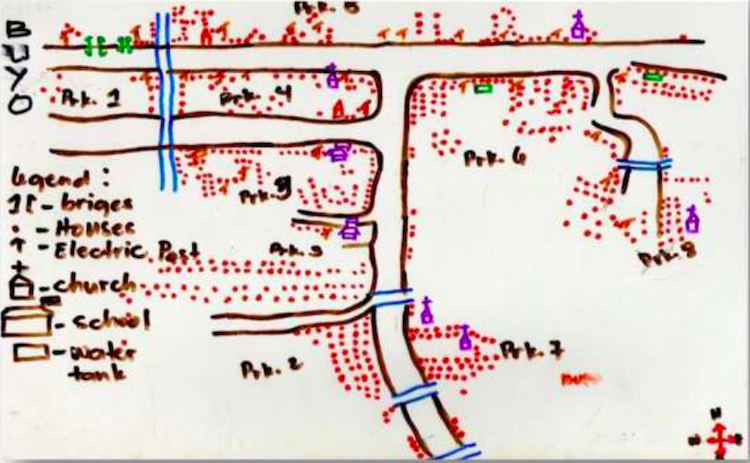
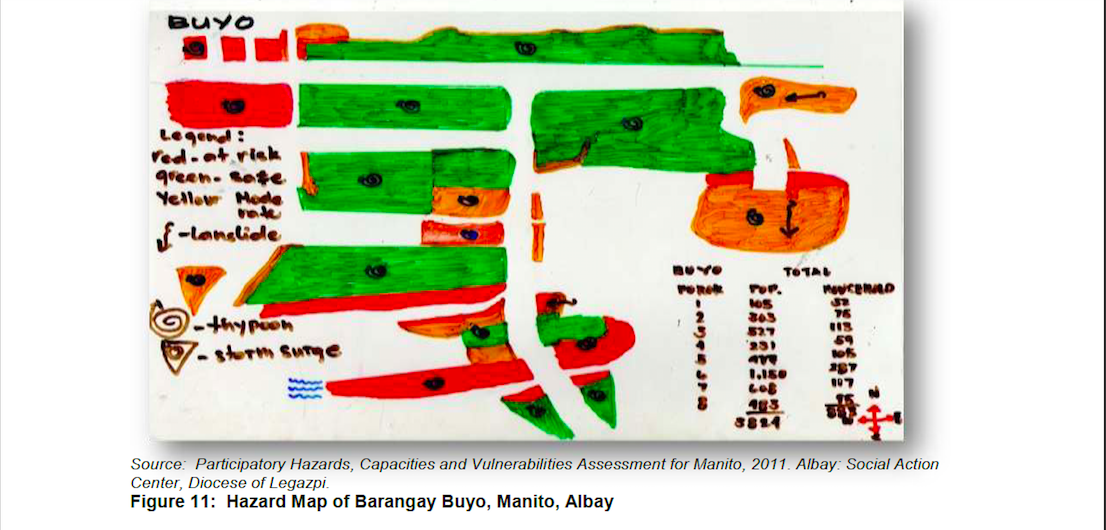
According to the study on Albay, information, communication, education, organization, and mobilization programs improve the communities’ sense of security and confidence. They allow the local communities to help themselves and inspire more community-based early warning systems. Below is an example of a social map and a hazard map of a village in Albay that the residents themselves made in a workshop facilitated by the church.
Also, the goodwill generated by the tragedy everywhere must be harnessed in the rebuilding. We can start asking the international community, including the international NGOs, for these things.
Being inclusive means being pro-poor. Most of those who were most severely affected were poor people in the coastal areas. Getting them involved in the process of rebuilding will help them cope with the trauma and even (yes, let’s be ambitious) overcome their pre-Yolanda poverty.
A lot of Eastern Visayans were hungry even before the super typhoon. Sixteen percent (or one in six) of almost one million families in Eastern Visayas experienced hunger in April, May, and June of 2011, according to the National Statistics Office, which conducted the survey in 2011 but released it only early this year.

Hardest hit by Yolanda, Eastern Visayas is the country’s third poorest region with 37.2 percent of its population (or an estimated 4.2 million people) living below poverty line, according to the National Statistical Coordination Board (NSCB) report for 2012. It came third after the Autonomous Region in Muslim Mindanao (which had a 46.9-percent poverty incidence) and Central Mindanao (37.5 percent).
The economic profile of the region for 2012 shows that despite having a gross domestic product of P228 billion, growth in the region is -6.2 percent, says the NSCB.
7. Eliminate poverty, inequality: Think BIG.
Make social protection universal. Firstly because it is a right, and secondly because the Eastern Visayans need it most now. The Network for Transformative Social Protection defines social protection as those that people need to live. The Asia-based network maintains that governments have the duty to provide these to their citizens: food, shelter, livelihood, health care, education, and basic utilities (water, power, telecommunications). These were partly discussed above.
And in place of the trickle-down effect, why not start from the bottom? The government’s conditional cash transfer (CCT) which gives out money to poor families in exchange for pregnant mothers going for pre-natal check-ups and for children going to school is a start. Why not change the game and expand the bottom-up idea by giving everyone a basic income guarantee (BIG) as a way of eliminating poverty and inequality? The idea of paying citizens a small amount of money enough to survive for simply living — perfect for the Yolanda survivors — is being proposed in Switzerland.
But it was in the Namibia village of Otjivero where the church and the local government co-funded the experiment for two years. There, BIG brought out the best in people. Instead of developing a mendicant mentality, those who received 100 Namibian dollars (about P433) every month gained dignity and became empowered. Much like the trust fund for rich people, BIG not only freed the poor from crushing poverty, it also enabled them to be fully human, living with dignity.
What were the BIG impacts? According to Herbert Jauch of the BIG Coalition in Namibia, it brought down the rates of poverty, unemployment, school drop-out, and crime. As both rich and poor received the allowance (if you will), the rich could not look down on the poor while there was no disincentive for the poor to becoming productive because whether they are or not, whether they wisely use the money and make it grow or not, they still got BIG.
A network in the United States is also campaigning for BIG, arguing too that unlike other social protection schemes, its universality makes it easier and cheaper to administer. Jauch calculates that expanding the program nationwide would be substantial, but cost only a fraction of both Namibia’s GDP (2.2 percent to 3 percent) and its national budget (5 percent to 6 percent). Or for a rough estimate for the Philippines, that’s about P113.25 billion to P135.9 billion, not even 14 times the amount of PDAF allegedly squandered through the bogus NGOs of Janet Lim-Napoles.
In the end, we don’t want to be like Haiti, caught up in the same or worse poverty cycle as before the 2009 earthquake that levelled the poor country.
Remember the goal is for a climate change-resilient, people-centered, green community. The money is there. The knowledge is there. Now, all we need is somebody to lead the way from here to there. –Veronica Uy, InterAksyon.com

10 essential lessons in political communication

Number one: All politics is personal.   In the 1960s, when women were burning bras and feminism (or the idea that women are equal to men) wa...